


GPS. Geofencing. Location Services. The world of location tech can feel like a maze of confusing terms. You know it’s happening on your phone, but how does it actually work, and who’s watching? It’s all powered by a technology called geo tracking, and it’s way simpler than you think. This is the real-time engine behind everything from getting live traffic updates to coordinating with your crew at a festival. It’s not magic-it’s just smart tech that saves you time and hassle.
This guide cuts through the noise. No complex jargon, no confusing diagrams. We’re breaking down exactly what you need to know, fast. You will understand how this technology works right on your smartphone, discover its most practical, everyday uses, and gain the confidence to manage your privacy settings like a pro. Forget the confusion. Let’s get you in control of your location data.
What is Geo Tracking? Beyond Just a Dot on a Map
At its core, geo tracking is the process of pinpointing the real-time location of a person or object and displaying it on a map. Forget static pins or outdated addresses. Think of it like a live, dynamic digital map that shows you exactly where your friends, vehicles, or assets are right now-not where they were five minutes ago. This “live” element is the key to its power and usefulness in everything from coordinating a group ride to managing a delivery fleet.
To see how this technology works in a practical setting, check out this quick overview:
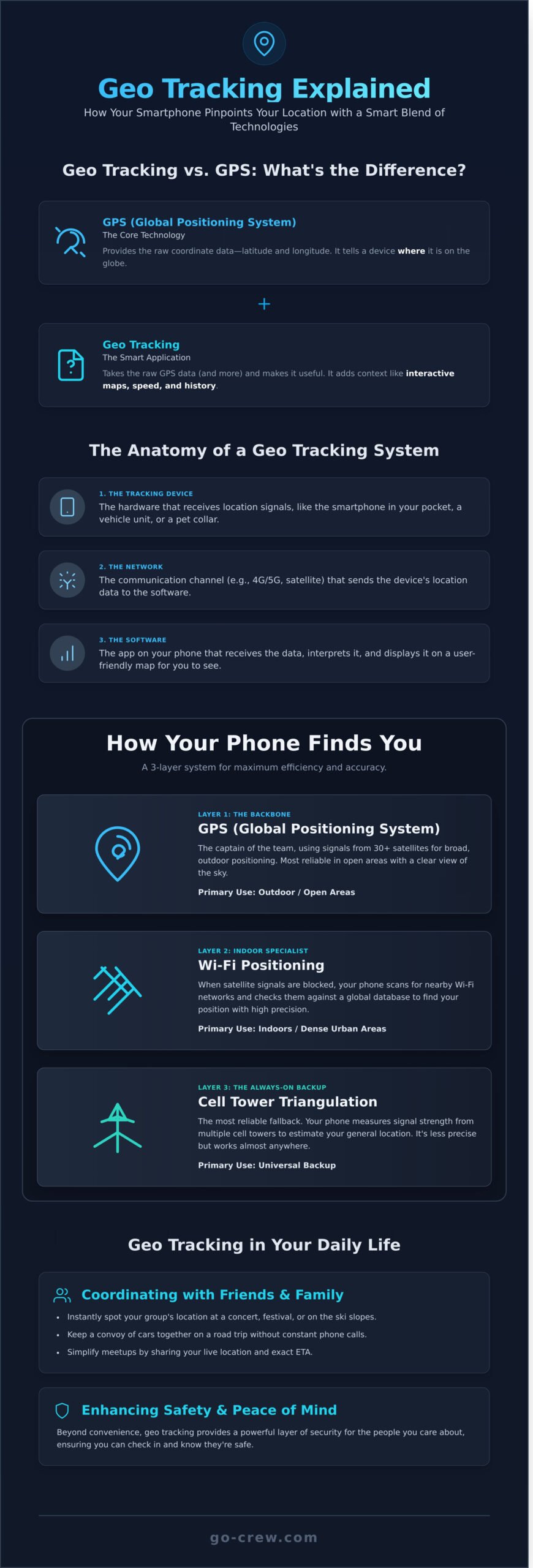
Geo Tracking vs. GPS Tracking: What’s the Difference?
People often use “GPS” and “geo tracking” interchangeably, but they aren’t the same. GPS (Global Positioning System) is the technology that provides the raw coordinate data-your latitude and longitude. It tells a device where it is. Geo tracking is the application that takes that raw data and makes it useful. It adds context like interactive maps, speed, direction, and location history. While GPS is crucial, modern systems often layer this with other data from Wi-Fi and cell towers. This blend of methods, known as Geopositioning technology, delivers a faster, more reliable location fix, especially where satellite signals can be weak.
The Three Core Components of Any Geo Tracking System
Every system, from a simple friend-finder to a complex logistics tool, relies on three essential parts working together. It’s a simple but powerful trio:
- The Tracking Device: This is the hardware that receives location signals. Most of the time, it’s the smartphone in your pocket, but it can also be a dedicated GPS unit in a car or a tag on a pet’s collar.
- The Network: The device needs a way to send its location data. This is handled by cellular networks (like 4G or 5G) and sometimes satellite signals, ensuring constant connectivity.
- The Software: This is where the magic happens. The software is the app on your phone-like Go Crew-that receives the data, interprets it, and displays it on a user-friendly map for you to see.
How Geo Tracking Works: The Technology Behind the Magic
Ever wonder how your phone knows exactly where you are on a map? It’s not magic-it’s a smart team of technologies working together. Modern geo tracking isn’t about one single system. Instead, your smartphone acts like a skilled manager, constantly choosing the best tool for the job to give you a fast, accurate location without draining your battery. It’s a seamless blend of space-age tech and ground-level signals working in perfect sync.
Think of it as a three-layer system designed for maximum efficiency:
- GPS for broad, outdoor accuracy.
- Wi-Fi for sharp, indoor precision.
- Cell Towers for a reliable, always-on backup.
GPS (Global Positioning System): The Backbone of Tracking
At the heart of it all is the Global Positioning System, or GPS. This is the captain of the team. A network of over 30 satellites is constantly circling the Earth, broadcasting signals. Your phone’s receiver picks up these signals from at least four different satellites and does some quick math, calculating how far it is from each one to pinpoint your exact location on the globe. The science behind it involves precise timing and trilateration, a process you can learn more about from the official government source explaining How GPS Technology Works. This makes GPS incredibly reliable for outdoor activities, especially in open areas with a clear view of the sky.
Wi-Fi Positioning: Pinpoint Accuracy Indoors
But what happens when you step inside a building or a crowded city where satellite signals can’t reach? That’s where Wi-Fi positioning takes over. Your phone scans for all nearby Wi-Fi networks-it doesn’t even need to connect to them. It then checks this list against a massive global database of Wi-Fi hotspots and their known physical locations. By recognizing which networks are around you, it can calculate your position with surprising accuracy, often down to a few meters. It’s the specialist for indoor and urban navigation.
Cell Tower Triangulation: The Always-On Backup
Finally, there’s the ever-present backup: cell tower triangulation. Your phone is always communicating with cellular towers to make calls and use data. By measuring the signal strength from multiple nearby towers, it can make a solid estimate of your general location. While it’s the least precise method of the three, it’s incredibly reliable. It works almost anywhere you have a phone signal, making it the dependable safety net that ensures your location service always has a baseline, even when GPS and Wi-Fi are unavailable.
Everyday Uses: How Geo Tracking Simplifies Your Life
Geo tracking isn’t just for navigating new cities or tracking packages. It’s a powerful tool woven into our daily lives, designed to save time, reduce stress, and connect us in real time. Moving beyond the technical, let’s explore the practical ways location sharing makes everyday tasks simpler and more efficient.
Coordinating with Friends and Family
Ever spent 20 minutes texting “where are you?” while trying to find your friends at a crowded festival or a huge park? Real-time group location sharing eliminates that chaos. Instead of guessing, you see everyone on a single map, making meetups instant and effortless.
- Find your crew: Instantly spot your group’s location at a concert, sporting event, or on the ski slopes.
- Stay together on the road: Keep a convoy of cars together on a road trip without constant phone calls.
- Simplify meetups: Share your live location for a few minutes so a friend can see your exact ETA.
Forget the frustration and get back to the fun. See how easy group coordination can be with Go Crew.
Enhancing Safety and Peace of Mind
Beyond convenience, geo tracking provides a powerful layer of security for the people you care about most. Sharing your location with a trusted circle can provide invaluable peace of mind in numerous situations. While it’s always important to understand Geolocation Privacy Concerns and manage your settings carefully, using this technology for safety is a game-changer. It allows you to:
- Confirm your kids arrived home safely from school.
- Share your live route with a partner during a late-night run or bike ride.
- Help emergency services pinpoint your location much faster in a critical situation.
- Keep an eye on elderly family members who may be prone to wandering.
Boosting Efficiency for Small Businesses
For small businesses with teams on the move, geo tracking is a streamlined solution for improving operations without the cost of complex hardware. A simple app on your team’s smartphones is all you need to gain real-time visibility. This allows you to confirm when a service technician has arrived on-site, track a small delivery fleet, and optimize routes to save significant time and fuel costs. It’s a simple, powerful way to boost productivity and improve customer service. Fast. Easy. Real-time.
Geofencing & Geotagging: The ‘Smart’ Features of Geo Tracking
Basic location tracking tells you where something is right now. But what if your tech could act on its own based on that location? That’s where geofencing and geotagging come in. These smart features turn passive tracking into a proactive, automated tool. They add a layer of convenience that saves you time and effort, making modern geo tracking an indispensable part of daily life.
What is Geofencing? Setting Up Virtual Boundaries
Think of geofencing as drawing an invisible circle around a real-world place on a map-like your office, a school, or a festival site. When a device with a tracking app enters or leaves this “geofence,” it automatically triggers a pre-set action. No manual checking required. It’s simple, fast, and works for you in the background.
- Peace of Mind: Get an instant alert when your child leaves the designated school area during class hours.
- Work Automation: Automatically log your work hours the moment you enter the office and clock out when you leave.
- Group Coordination: Notify your riding crew when you arrive at the meetup point, so they know you’re ready to go.
What is Geotagging? Adding ‘Where’ to Your Digital Life
Geotagging is the simple act of attaching location data to a piece of digital media. It’s the “where” information stamped onto your photos, social media posts, or notes. This simple tag makes your digital content instantly more organized and useful, turning a random photo into a specific memory tied to a place.
- Smart Photo Albums: Your phone’s gallery automatically organizes pictures by location, grouping all your vacation shots together without you lifting a finger.
- Social Sharing: When you “check in” at a concert or tag a restaurant in your post, you are using geotagging to share your experience.
- Never Lose Your Car: Many parking apps use geotagging to drop a pin where you parked, making it effortless to find your vehicle in a massive lot.
Together, these features upgrade geo tracking from a simple dot on a map to a powerful assistant. They automate tasks and provide context, giving you crucial information exactly when you need it. For organizing real-time events, this level of automation is a game-changer. Apps like Go Crew are built on these principles to make group coordination faster and simpler than ever.
Privacy and Geo Tracking: Staying Safe and In Control
Let’s address the biggest question about location sharing: privacy. It’s a valid concern. But modern geo tracking isn’t about surveillance; it’s about connection and safety, and you are always in the driver’s seat. The key is understanding that legitimate, user-focused technology puts control directly into your hands. When used responsibly, it’s a powerful tool for coordinating with your crew, not a way for others to watch you.
The Golden Rule: Tracking Must Be Consensual
This is non-negotiable. Tracking anyone without their explicit consent is unethical and, in many places, illegal. Reputable apps will always ask for your permission before sharing anything. They are built on trust and user control, offering features like temporary location sharing-for one hour, or just for the duration of an event. This is the opposite of spyware, which operates secretly and maliciously. Always choose transparency.
Managing Your Smartphone’s Location Settings
Your phone gives you complete control over who sees your location and when. Take a minute to get familiar with these settings. On both iOS (Settings > Privacy & Security > Location Services) and Android (Settings > Location > App permissions), you can decide how each app accesses your data. You can choose ‘Always Allow’, ‘While Using the App’, ‘Ask Next Time’, or ‘Don’t Allow’. Our advice? Regularly review these permissions and remove access for any apps that don’t absolutely need it.
Tips for Using Geo Tracking Apps Safely
Staying in control is simple. Keep these best practices in mind to ensure your location sharing is always safe, secure, and on your terms:
- Share with your trusted circle. Your location is personal information. Only share it with friends, family, or crew members you know and trust.
- Use apps with easy on/off controls. The best apps make it incredibly simple to start and stop sharing your location with a single tap. You should never feel stuck “on.”
- Understand the privacy policy. Take a quick look at how an app handles your data. Legitimate developers will be transparent about what they collect and why.
- Be mindful of social media. Avoid posting real-time, specific location data publicly. Save the check-ins and photo tags for after you’ve left.
Ultimately, location sharing is a tool for convenience and peace of mind. Apps designed with user control in mind make it easy to find your friends at a festival or coordinate a group ride, all while keeping your privacy protected.
Putting Geo Tracking to Work for You
From navigating new cities to getting timely alerts, geo tracking has fundamentally changed how we interact with the world. We’ve seen it’s a smart blend of GPS, Wi-Fi, and cellular data that powers these everyday conveniences, making our lives simpler and more connected. The key is to harness its power for good while always staying in control of your privacy.
But what about using this power to solve one of the most common frustrations: coordinating your crew? That’s where Go Crew comes in. Forget the endless “where are you?” texts and confusing meeting points. We make group location sharing fast, easy, and secure. With real-time tracking for ultimate accuracy and a user-friendly interface designed for simplicity, it’s the perfect tool for groups, events, and small teams.
Ready to simplify your group meetups? Try Go Crew for free! Stop waiting and start connecting. It couldn’t be easier.
Frequently Asked Questions About Geo Tracking
Does geo tracking use a lot of phone battery?
Yes, continuous geo tracking can be a significant drain on your battery. The GPS chip in your phone requires a lot of power to constantly communicate with satellites. However, the exact impact depends on the app and its settings. Apps that provide real-time, second-by-second updates will use far more power than those that check your location every few minutes. Modern smartphones and apps have optimizations to minimize this drain, but it’s always a trade-off between accuracy and battery life.
Can someone use geo tracking to find me without my knowledge?
On your personal smartphone, it’s very difficult for someone to track you without your consent. Both iOS and Android require you to grant explicit permission for an app to access your location data. You are in control and can revoke this access at any time in your phone’s settings. The real danger comes from malicious spyware or if someone gains physical access to your unlocked device and changes your settings. Always be cautious about the apps you install and the permissions you grant.
What is the difference between active and passive geo tracking?
It’s all about timing. Active tracking provides a live, real-time data stream of a location, sending updates continuously. Think of watching your Uber driver approach on the map-that’s active tracking. Passive tracking collects location data at preset intervals or when a specific event happens, like entering or leaving an area. It’s less battery-intensive and is often used for logging a journey or analyzing location patterns over time rather than for immediate live viewing.
Do I need to buy a special device for geo tracking, or can I just use my phone?
For most personal uses, like sharing your location with friends or navigating, your smartphone is all you need. It has a powerful, built-in GPS receiver that works perfectly with countless apps. Dedicated devices are designed for more specific, demanding tasks. For example, businesses use them for fleet management to track company vehicles, and some people use them for tracking pets or valuable assets. But for everyday group location sharing, your phone is the simple, fast solution.
How accurate is geo tracking on a typical smartphone?
You’d be surprised how precise it is. In ideal conditions with a clear view of the sky, the geo tracking on a modern smartphone is typically accurate to within 5 meters (about 16 feet). However, accuracy can decrease in dense urban areas with tall buildings (an “urban canyon”), indoors, or in areas with poor satellite signal. For most activities like meeting up with friends or tracking a bike ride, this level of accuracy is more than enough to be effective.
Does geo tracking work without an internet connection?
Yes and no. The GPS function itself does not require an internet or cellular connection. Your phone’s GPS receiver communicates directly with satellites orbiting the Earth to determine your coordinates. However, to display those coordinates on a visual map (like in Google Maps or Waze), your phone needs an internet connection to download the map images. Some apps allow you to download maps in advance for offline use, giving you the best of both worlds.
