


Feeling lost in tech-speak? Real-time, cellular, GPS… it can be a lot. You’re trying to choose between a physical device and a phone app, all while worrying about hidden fees and privacy. Finding the right gps tracker shouldn’t be this complicated. We believe in keeping things simple and fast.
This is your ultimate guide. We cut through the noise to show you exactly how GPS tracking works, in plain English. You’ll understand the key differences between hardware and apps, so you can confidently pick the perfect solution for your car, your pet, or your team. Get ready to find an easy, affordable, and secure way to keep tabs on what matters most. No more guesswork, just clear answers.
What is a GPS Tracker and How Does It Actually Work?
Ever played a game of “Marco Polo”? A gps tracker works on a similar principle, but on a global scale. Instead of a friend shouting in a pool, you have a network of satellites in space broadcasting signals. The tracker is the player in the “pool” listening for those signals to figure out its exact location. It’s that simple.
To see how this all comes together, check out this quick video for a visual breakdown:
Every GPS tracking system, from a device on your vehicle to an app on your phone, relies on three core components working together: the satellite network, the receiver (the tracker itself), and the user interface (your map). First, the tracker pinpoints its location. Then, it sends that data to you. Let’s break it down.
The Science in a Nutshell: Satellites and Receivers
The Global Positioning System (GPS) is a constellation of satellites orbiting Earth, each constantly broadcasting a signal with its precise location and time. At its core, a GPS tracking unit is a sophisticated receiver that listens for these signals. By calculating the time difference between receiving signals from at least four different satellites, it triangulates its own position on the globe. Accuracy is best with a clear view of the sky and can be reduced by tall buildings or dense forests.
Getting the Data to You: Cellular vs. Satellite Transmission
Once the tracker knows where it is, how do you see it on your map? Most dedicated hardware trackers transmit this data using cellular networks, just like a smartphone. This is why many require a monthly subscription-you’re paying for the SIM card and data plan inside the device. For adventures far off the grid, satellite messengers use a satellite network instead, which works anywhere but often comes at a higher cost. Phone apps simply use your phone’s built-in internet connection (Wi-Fi or cellular data) to share its location.
Types of GPS Trackers: Hardware Devices vs. Smartphone Apps
When you need to track something, your first and most important choice is deciding how you’ll track it. The world of GPS tracking is split into two main camps: dedicated hardware devices and software-based smartphone apps. There’s no single “best” option-the right choice depends entirely on what or who you need to locate.
Let’s break down the difference. It’s simple: are you tracking a thing or a person?
Dedicated Hardware Trackers (The Little Black Boxes)
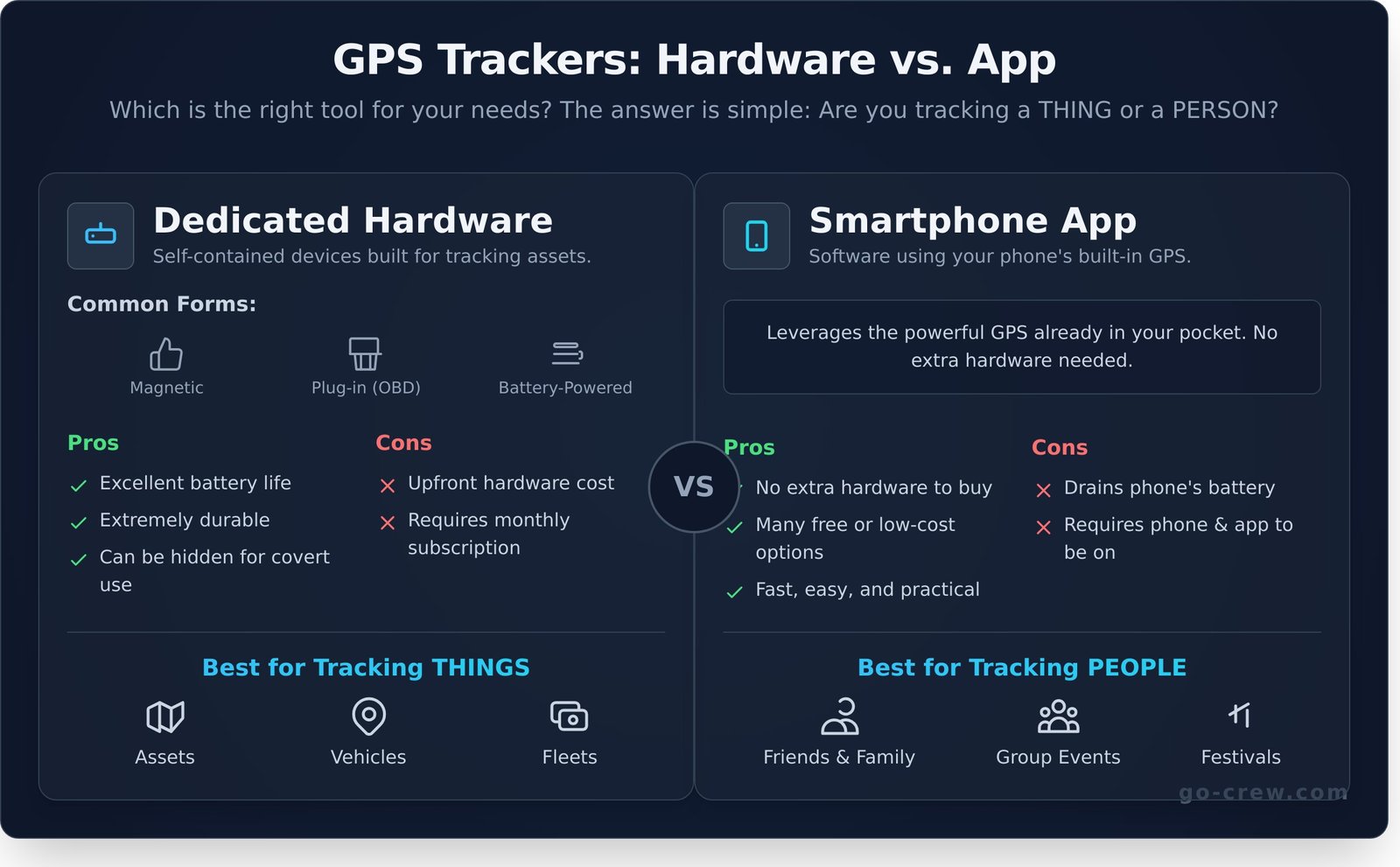
A dedicated hardware gps tracker is a small, self-contained device built for one purpose: reporting its location. These units contain their own GPS receiver, battery, and a SIM card to transmit data. They come in several common forms:
- Magnetic: Slap it onto a vehicle or metal asset. Simple and fast.
- Plug-in (OBD): Plugs directly into a car’s diagnostic port for continuous power.
- Battery-Powered: Compact units with long-life batteries, perfect for equipment or cargo.
These devices use the same core satellite technology that powers navigation everywhere; you can find the Official U.S. government information about GPS online to learn more. Their focused design makes them incredibly reliable for asset protection.
Pros: Excellent battery life, extremely durable, and can be hidden for covert tracking.
Cons: Requires an upfront hardware purchase and usually a monthly data subscription.
Best For: Vehicles, valuable assets, fleet management, and any situation where you are tracking an object, not a person.
Software-Based Trackers (Your Smartphone)
Instead of buying new hardware, you can use the powerful GPS tracker already in your pocket: your smartphone. Software-based trackers are simply apps that use your phone’s built-in GPS capabilities to share its location in real-time. This method turns your phone into a multi-purpose tracking device without any extra cost.
Pros: No extra hardware needed, and many apps are free or low-cost.
Cons: Drains the phone’s battery, and tracking only works if the person has their phone with them and the app is running.
Best For: Coordinating with friends, keeping track of family members, or sharing your location with a group during an event like a road trip or festival.
Which One is Right For You?
The choice is straightforward. If you need to monitor a car, a piece of equipment, or any valuable asset, a dedicated hardware gps tracker is the clear winner for its reliability and long-term performance. But if your goal is to coordinate with people and see where your friends are in real-time, a location-sharing app is the faster, easier, and more practical solution.
For group location sharing that is fast, simple, and designed for events, Go Crew is the ideal tool. No complicated setups, just real-time tracking for your whole crew. See how Go Crew makes group tracking easy.
Common Uses for GPS Trackers: From Vehicles to Group Rides
A GPS tracker is far more than a dot on a map; it’s a versatile tool that solves real-world problems. The technology, which relies on a network of satellites as detailed in the Official U.S. Government information about GPS, has applications that stretch from protecting high-value assets to simply keeping your friend group together. Understanding these common uses will help you identify which type of tracker-a dedicated hardware device or a simple mobile app-is the right fit for your needs.
Vehicle and Asset Tracking
For high-value physical assets, security is non-negotiable. This is where dedicated hardware trackers are essential. They are designed for one job: to protect and monitor things that move. Common applications include:
- Anti-Theft: Get instant alerts and real-time location if your car, motorcycle, or RV is moved without permission.
- Fleet Management: Businesses can monitor company vehicles to optimize routes, track driver behavior, and improve overall efficiency.
- Valuable Shipments: Track expensive equipment or cargo from point A to point B, ensuring it never goes missing.
These scenarios demand a reliable, always-on hardware solution, often hardwired into the vehicle’s power source for constant tracking.
Personal Safety: Kids, Seniors, and Lone Workers
Providing peace of mind is one of the most powerful uses for a GPS tracker. Whether it’s for a child walking home from school, an elderly parent with dementia, or an employee working alone in a remote area, location tracking offers a crucial safety net. Solutions here are flexible-it could be a small, wearable hardware device (like a watch or pendant) or a location-sharing app installed on a smartphone, allowing for quick check-ins and emergency alerts.
Group Activities and Events
Ever tried finding friends in a massive festival crowd or keeping your cycling group together on a winding trail? This is where location-sharing apps eliminate the chaos. Instead of endless “where are you?” texts and missed calls, everyone can see each other on a live map in real-time. This is the perfect use case for a fast, simple app like Go Crew, designed specifically for coordinating groups on the move without the clutter of other features. Easy. Fast. Real-time.
Key Features to Consider Before You Choose
Finding the right GPS tracker goes beyond the price tag. The best solution is a combination of powerful hardware and intuitive software that fits your specific needs. Whether you’re tracking a vehicle, a pet, or coordinating a group, focus on the features that deliver real value. Use this checklist to see what truly matters.
Tracking and History Features
The core function of any tracker is to show you a location on a map. But the quality of that data makes all the difference. Look for a solution that offers precision and context, not just a pin on a map.
- Real-Time Updates: How “live” is the tracking? Some devices only refresh every few minutes, which isn’t helpful for fast-moving assets. For activities like group motorcycle rides or event coordination, you need updates every few seconds for true real-time visibility.
- Location History: A great feature for reviewing a trip, checking an employee’s route, or simply seeing where your tracker has been. The best apps let you easily play back a day’s journey with timestamps and stop details.
- Speed and Heading: Knowing the speed and direction of travel is critical for coordinating groups and ensuring safety. This data provides a much clearer picture than a simple location dot.
Alerts and Geofencing
A modern gps tracker is proactive. It doesn’t just wait for you to check it-it notifies you when something important happens. Geofencing is a key feature here, allowing you to create virtual boundaries on a map. When a tracker crosses that line, you get an alert.
- Zone Alerts: Get instant notifications when a tracker enters or leaves a designated area. This is perfect for knowing when your kids arrive at school or if a valuable asset leaves a job site.
- Behavior Alerts: Many devices can send alerts for specific events like speeding, harsh braking, or even when the device is tampered with.
- SOS and Battery Alerts: Personal trackers often include an SOS button that sends an emergency alert with your location to pre-selected contacts. A low-battery notification is also essential to ensure your device is always ready to go.
Battery Life and Ease of Use
The most advanced features are useless if the device is always dead or the software is a headache to navigate. Practicality is paramount.
For hardware, battery life can range from a few days for small, portable trackers to several months or even years for hardwired vehicle units. Match the battery performance to your use case. On the software side, the app should be fast and efficient, providing critical information without draining your phone’s battery.
Ultimately, the entire experience should be seamless. A complicated interface with a steep learning curve defeats the purpose of quick and easy location sharing. The best systems are powerful yet simple. Go Crew is built for simplicity and speed. Try it now.
Understanding Costs, Privacy, and Legality
GPS technology is powerful, but using it responsibly means understanding the full picture. Before you invest in a tracking device or app, it’s crucial to get clear on the associated costs, privacy ethics, and legal boundaries. Getting this right builds trust and ensures you use this tech effectively and fairly.
The True Cost of GPS Tracking
The price tag on the box is rarely the final cost. Most tracking solutions involve a mix of one-time and recurring fees. Here’s a simple breakdown:
- Hardware Costs: This is the one-time purchase price of the physical gps tracker. Prices can range from $20 for a simple tag to over $200 for advanced units with long-life batteries and specialized features.
- Subscription Fees: Why the monthly fee? Hardware trackers need a cellular connection (like a phone) to send real-time location data to your app. The subscription, typically $5 to $25 per month, covers this data usage and server access. It’s the price of getting instant, accurate updates from anywhere.
- App Costs: Many tracking solutions are purely software-based, turning your smartphone into the tracking device. For simple, real-time group location sharing without extra hardware, solutions like the Go-Crew app provide a powerful and straightforward alternative, often using a free or premium subscription model.
Privacy and Consent: The Golden Rules
Using a tracking device ethically is non-negotiable. It all comes down to two simple principles: ownership and consent. To ensure you’re using GPS technology responsibly, always stick to these golden rules.
- Rule #1: Only track property you own. This is the clearest and most common use case. Placing a tracker on your car, motorcycle, equipment, or even your pet’s collar is perfectly acceptable. You own it, you can track it.
- Rule #2: Only track people with their explicit consent. Whether it’s your child for safety, a group of friends at a festival, or an employee using a company vehicle, they must know they are being tracked and agree to it. Transparency builds trust and is often a legal requirement. For employees, a clear, written company policy is essential.
Remember, laws regarding GPS tracking can vary significantly by state and country. What is permissible in one region may be illegal in another. Always check your local regulations to ensure you are fully compliant.
Simplify Your Journey: The Right Tracking Solution Awaits
Navigating the world of location tracking is all about matching the right technology to your goal. As you’ve seen, the best gps tracker solution-whether a dedicated hardware device or a modern smartphone app-is the one that fits your specific needs for features, cost, and privacy. The key is understanding your purpose, from securing an asset to coordinating a live event.
If your goal is effortless group coordination, the answer is already in your pocket. Go Crew is built on the core principles of TIME-SAVING & SIMPLICITY. Experience seamless, real-time location sharing for your entire crew with no extra hardware needed-just your phone. It’s fast, user-friendly, and designed to keep everyone connected without complication.
Group location sharing couldn’t be easier than this.
Ready for easy group tracking? Download Go Crew for free!
Stop wondering and start tracking. Your next adventure is waiting.
Frequently Asked Questions About GPS Trackers
Can a GPS tracker work without a SIM card or cell service?
A GPS tracker needs satellites to find its position, which works without cell service. However, to send that location to your phone in real-time, it needs a way to communicate. Most trackers use a SIM card for a cellular connection to achieve this instant data transfer. Devices without a SIM are typically “loggers”-they record the route, but you must physically retrieve the device to see the data. For live tracking, a SIM is essential.
How accurate is a typical GPS tracker?
Most modern GPS trackers are incredibly accurate, pinpointing a location within 5 meters (16 feet) under clear skies. Think of it as being able to tell which parking spot a car is in. Accuracy can be slightly reduced in dense urban areas with tall buildings or under heavy tree cover, as these can interfere with the signal from satellites. For most uses, from tracking a vehicle to finding friends at a festival, the precision is excellent.
Is it legal to put a GPS tracker on someone’s car?
This is critical: legality depends on ownership and consent. You can legally track a vehicle that you own. Parents are also often permitted to track the cars of their minor children. However, placing a GPS tracker on someone else’s car without their knowledge and consent is illegal in most places and can have serious legal consequences, including stalking charges. Always check your local laws and prioritize consent before using a tracking device.
What’s the difference between a GPS tracker and something like an Apple AirTag?
Think of it as a telescope versus a metal detector. A true GPS tracker uses satellites to find its precise location anywhere in the world and sends it to you in real-time via a cellular network. It’s built for tracking things on the move over long distances. An AirTag is a Bluetooth finder. It has no GPS and only works when it’s near another Apple device. It’s perfect for finding your keys in the house, not for tracking a car across town.
How much battery does a GPS tracking app use on a smartphone?
Let’s be direct: active GPS tracking is one of the biggest battery drains on your phone. Keeping the GPS radio and data connection constantly active for real-time updates uses significant power. While apps have battery-saving modes, you can expect a noticeable drop. For a long day at a festival or a multi-hour bike ride, it’s smart to start with a full charge and carry a power bank to stay connected with your group without interruptions.
Can I use a single app to track my whole family?
Absolutely. That’s exactly what modern location-sharing apps are for. You can create a private, secure group for your family or friends. Each person just needs the app on their phone and must grant permission to share their location with the group. This puts everyone on a single, real-time map, making it incredibly easy to coordinate meetups, check that kids got home safely, or find each other in a crowd. Group location sharing couldn’t be easier.
