



Feeling trapped by expensive GPS trackers, complicated installations that take your vehicles off the road, and long-term contracts that stifle your business? You know you need to see your team’s location to stay competitive, but getting drivers on board with a ‘spy box’ is a battle you don’t want to fight. There’s a better, simpler way. The future of efficient fleet management is already here, and it fits right in your pocket. Welcome to the world of fleet tracking without hardware, where your team’s own smartphones become your most powerful operational tool.
This is your ultimate guide for 2026. Forget hefty upfront investments and setup headaches. We’ll show you exactly how to leverage smartphone technology to see your entire team in real-time. Discover how to improve routing, provide accurate ETAs to customers, and implement a simple, user-friendly system that your drivers will actually embrace. It’s time to get started in minutes and take control of your fleet operations. The smart way.
Key Takeaways
- Turn your team’s existing smartphones into powerful GPS trackers. No installation, no extra costs.
- Discover the key advantages of app-based tracking, from massive cost savings to instant setup and greater flexibility.
- Get a clear comparison to decide if fleet tracking without hardware is the right, modern solution for your business.
- Learn exactly what to look for in a tracking app and how to ensure smooth team adoption from day one.
What is Hardware-Free Fleet Tracking (and How Does It Work?)
Forget clunky black boxes and complicated installations. Hardware-free fleet tracking is the modern, simple way to see your team’s location in real-time. Instead of dedicated hardware, this approach turns every team member’s smartphone into a powerful GPS tracking device.
The concept is simple: a lightweight app uses the phone’s built-in GPS and mobile data to report its location. This shift from installed devices to software makes fleet management accessible, affordable, and incredibly fast to set up, especially for small and medium-sized businesses.
To see how this works in practice, check out this quick overview:
The Old Way: Traditional Hardwired Trackers
Traditionally, a vehicle tracking system required a physical device. These ‘black boxes’ were either plugged into a vehicle’s OBD-II port or hardwired directly into its electrical system. This meant high upfront hardware costs, scheduling professional installations, and dealing with vehicle downtime-a major headache for any business.
The New Way: App-Based Tracking on Smartphones
The new way is all about simplicity and speed. Using a Bring Your Own Device (BYOD) model, drivers simply download an app onto their existing smartphones. Managers invite them to a group, and tracking begins instantly. A central web or mobile dashboard gives you a live map view of your entire team, making coordination effortless. It’s fleet tracking without hardware getting in the way.
Ideal Use Cases for Hardware-Free Solutions
This flexible approach is perfect for any business with a mobile workforce that needs simple, real-time visibility. It excels in environments where speed and low cost are critical. Key examples include:
- Field Sales & Service Teams: Quickly dispatch the nearest technician or sales rep to a new job.
- Local Delivery Services: Optimize routes on the fly and provide customers with accurate ETAs.
- Mobile Crews: Coordinate landscaping, cleaning, or construction teams across multiple job sites.
- Event Staff & Logistics: Keep track of team members spread across a large venue or area.
Key Advantages of App-Based Fleet Tracking
Choosing fleet tracking without hardware isn’t just a trend; it’s a strategic move toward a more agile, cost-effective, and efficient way to manage your mobile workforce. By ditching cumbersome black boxes and embracing the power of smartphones, you unlock immediate benefits that directly address the biggest pain points of traditional systems. This modern approach is all about speed, simplicity, and savings.
Eliminate Upfront Costs & Reduce Overall Spend
The most significant barrier to traditional fleet tracking is the massive upfront investment. Hardwired GPS units can cost hundreds of dollars per vehicle, plus installation fees. With an app-based solution, that cost is zero. You leverage the devices your team already owns.
Instead of getting locked into rigid, long-term contracts, you gain the flexibility of a Software-as-a-Service (SaaS) model with predictable, low monthly payments.
Cost-Saving Example (5-Vehicle Fleet):
- Traditional Hardware: $150 per device + $100 per installation = $1,250 Initial Cost
- App-Based Tracking: $0 Initial Cost
You save over a thousand dollars instantly, money that can be reinvested directly back into your business.
Achieve Instant Setup & Effortless Scalability
Forget scheduling appointments with installers and taking vehicles off the road. You can deploy an entire app-based tracking system in the time it takes to drink a cup of coffee. The process is incredibly simple:
- Create your manager account online.
- Send email or SMS invites to your drivers.
- Drivers download the app, log in, and are instantly visible on your map.
You’re operational in minutes, not weeks. This agility extends to scaling your team. Adding a new driver or removing a departing one is as easy as a few clicks in your dashboard. This makes fleet tracking without hardware the perfect fit for dynamic businesses with changing needs.
Increase Flexibility with Bring Your Own Device (BYOD)
Leverage the powerful computer your drivers already carry in their pockets. The Bring Your Own Device (BYOD) model eliminates the need to purchase, manage, and maintain a separate set of tracking hardware. This approach is a core feature of many of the best fleet management software solutions because it streamlines operations for everyone. Drivers get to use a familiar interface on a single device, and managers are freed from the headache of equipment logistics and replacement costs.
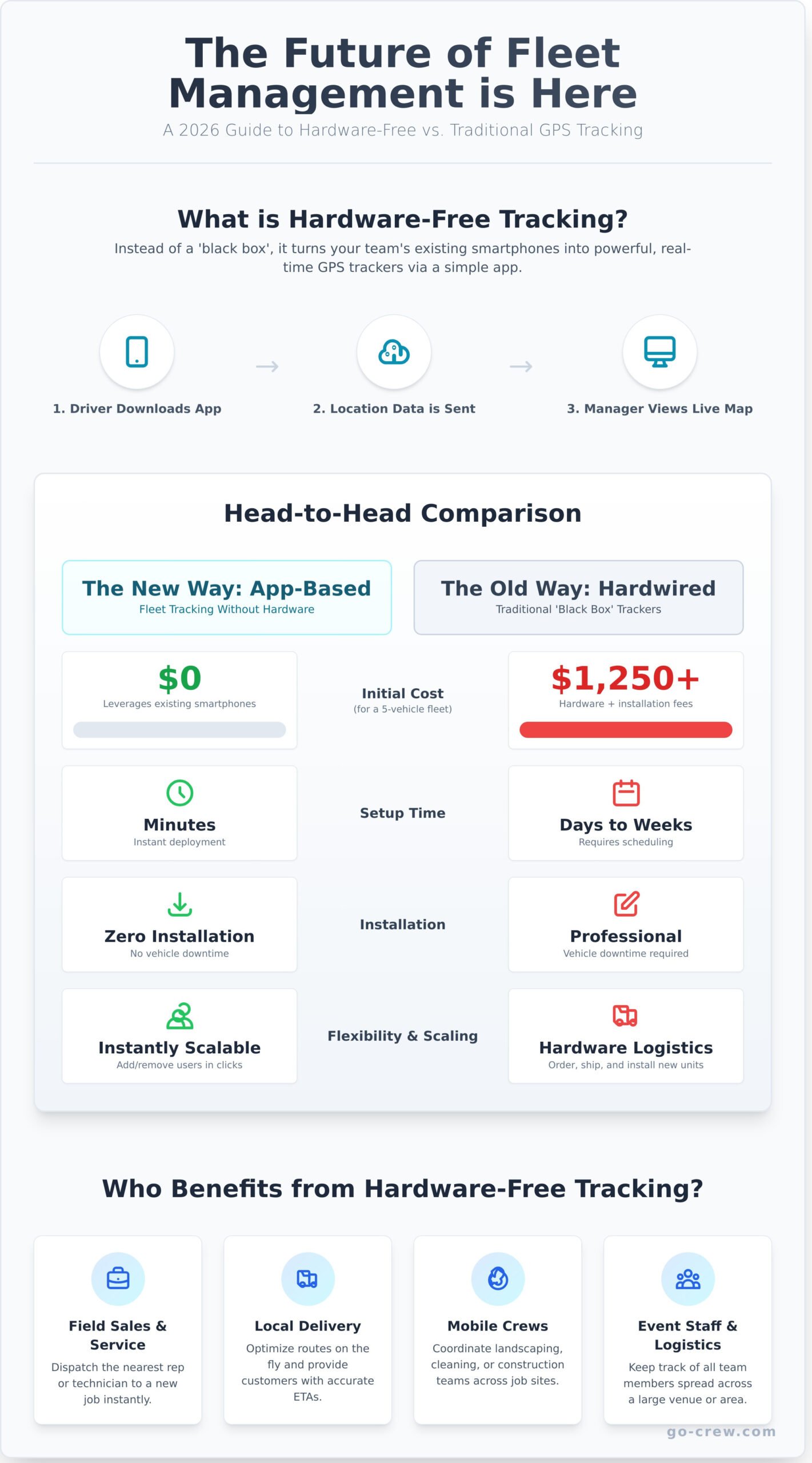
Hardware vs. App-Based Tracking: A Head-to-Head Comparison
Choosing the right fleet tracking system can feel overwhelming. Traditional hardware has been the standard for years, but modern app-based solutions are changing the game. To help you make an informed decision, let’s break down the key differences directly. There’s no single “best” answer-only what’s best for your business.
- Feature
- Hardware-Based Tracking
- App-Based (No-Hardware) Tracking
- Cost & Contracts
- High upfront device cost, installation fees, and long-term contracts.
- Low or no upfront cost, flexible monthly subscriptions, easy to cancel.
- Installation & Maintenance
- Requires professional installation, causing vehicle downtime. Risk of device failure.
- Instant download from an app store. Updates are automatic. Zero downtime.
- Data & Accuracy
- Can pull deep vehicle diagnostics (OBD-II). Highly reliable signal.
- Provides excellent GPS location data. Accuracy depends on the smartphone.
Cost & Contract Flexibility
Hardware systems often come with significant upfront costs for the devices, plus installation fees and binding multi-year contracts. In contrast, app-based tracking operates on a flexible subscription model. You pay a low monthly fee per user with no long-term commitments, making it the ideal choice for small businesses, startups, or any company wanting to control cash flow and scale on demand.
Installation & Maintenance
Getting started with hardware means scheduling professional installation, which can lead to vehicle downtime and lost revenue. App-based solutions are all about speed and simplicity. Your drivers download an app, and you’re ready to go in minutes. Updates are handled automatically through the app store, eliminating worries about device failure or costly maintenance calls. This is the core of fleet tracking without hardware-it just works.
Data & Accuracy
This is where the primary difference lies. Hardware trackers that plug into a vehicle’s OBD-II port can pull rich diagnostic data like fuel consumption and engine fault codes. App-based systems focus on the core essential: providing highly accurate, real-time GPS location data. For businesses whose primary need is knowing where their team is and optimizing routes, modern smartphone GPS is more than powerful and reliable enough.
Ultimately, the right choice depends on your priorities. If you require deep vehicle telematics and have the budget for a long-term investment, hardware is a viable option. However, for businesses prioritizing flexibility, affordability, and rapid deployment, an app-based solution is the clear, modern, and efficient choice.
Key Features to Look for in a Hardware-Free Tracking App
Choosing the right app is the most critical step in implementing effective fleet tracking without hardware. Not all software is created equal. The best solutions are powerful for managers but incredibly simple for drivers. Use this practical checklist to evaluate your options and find a tool that your team will actually want to use.
Real-Time Location and Trip History
At its core, a tracking app must provide instant, accurate visibility. You need more than just a dot on a map; you need context. Look for a platform that delivers a clear operational picture at a glance.
- Unified Map View: The ability to see your entire team’s live location on a single, easy-to-read map is non-negotiable.
- Historical Data: Accessing past trip logs is essential for verifying service calls, analyzing route efficiency, and resolving disputes.
- Clear Status Indicators: Instantly know if a team member is moving, stopped, or has paused their tracking for the day.
Ease of Use for Both Managers and Drivers
Complexity is the enemy of adoption. If an app is clunky or confusing, your team won’t use it consistently. The entire experience, from setup to daily operation, should be effortless. A system that focuses on simplicity saves everyone time and eliminates friction.
For managers, this means an intuitive dashboard that presents vital information without clutter. For drivers, it means a lightweight app that runs quietly in the background, requiring minimal interaction. Adding a new team member should take minutes, not hours of training.
Essential Privacy Controls and Battery Optimization
Trust is the foundation of any successful fleet tracking without hardware program. Drivers need to know their privacy is respected and their personal device won’t be compromised. A reputable app provider will be transparent and prioritize the user experience.
- Driver-Controlled Tracking: Give your team the ability to easily pause or stop location sharing after their shift ends. This builds trust and respects work-life balance.
- Minimal Battery Drain: The app should be engineered for efficiency, ensuring it doesn’t significantly drain a phone’s battery during the workday.
- Clear Privacy Policy: The provider should clearly state what data is collected and how it is used, with no hidden clauses.
The right tool enhances efficiency without creating new problems. See how Go Crew delivers time-saving & simplicity with a user-first approach designed for the real world.
Overcoming Common Challenges & Encouraging Team Adoption
Implementing any new technology requires a smart rollout. For a solution like fleet tracking without hardware, being proactive and transparent is the key to success. Addressing concerns head-on builds trust and ensures your team sees the new system as a tool for efficiency, not just oversight.
Here’s how to navigate the common hurdles and get your team on board quickly.
Addressing Battery and Data Usage Concerns
The most common questions are about phone performance. Modern tracking apps are built for efficiency. They use smart location updates to keep battery drain minimal-often less than popular social media apps. Data usage is also surprisingly low, typically consuming only 20-30 MB per month. For total peace of mind, consider offering a small monthly phone bill stipend.
Winning Over Drivers and Respecting Privacy
Your team’s trust is everything. The key is to communicate the “why” behind the change. Frame it as a benefit that makes their job easier and safer, not a method of micromanagement.
- Less Interruption: Real-time location means fewer “Where are you?” calls from dispatch.
- Enhanced Safety: You can send help to an exact location in an emergency, fast.
- Total Transparency: Be clear about what is tracked and only during work hours. Highlight features that allow drivers to manually stop tracking after their shift ends, giving them full control over their privacy.
What if a Phone is Turned Off or Has No Service?
This is a valid limitation for any phone-based system. The good news? Most apps are designed to handle it. They will cache location data and automatically upload it once the phone reconnects to a network. This small trade-off is a minor issue when weighed against the immense cost savings and flexibility that fleet tracking without hardware provides.
Ultimately, a successful rollout comes down to clear communication and choosing a simple, driver-friendly tool. With the right approach and a user-focused platform like Go Crew, you can implement a powerful system that your entire team values. It’s about working smarter, together.
Ditch the Hardware, Drive Your Business Forward
The future of fleet management is here, and it fits right in your pocket. As we’ve seen, the shift away from clunky, expensive GPS devices is accelerating. App-based solutions deliver the same powerful, real-time data without the high costs, complex installations, or long-term contracts. This move towards agility and simplicity is the defining advantage of modern fleet tracking without hardware, giving businesses of all sizes the flexibility to scale and adapt instantly.
The choice is clear. You can stick with outdated systems or embrace a solution built for speed and efficiency. Go Crew is designed around one core principle: TIME-SAVING & SIMPLICITY. There’s no hardware to buy or install, and your team can be up and running in under a minute. It’s group location sharing that couldn’t be easier.
Stop managing devices and start managing your team effectively. Ready for fleet tracking without the hassle? Try Go Crew!
Empower your crew with the tools they need to succeed and take your operations to the next level. Your more efficient future is just a tap away.
Frequently Asked Questions
How accurate is fleet tracking using a smartphone’s GPS?
Extremely accurate. Modern smartphones provide location data that is typically precise within 5-10 meters. This is achieved by using a combination of GPS, Wi-Fi positioning, and cell tower triangulation. For business purposes like verifying job site arrivals, optimizing routes, and confirming deliveries, this level of accuracy is more than sufficient and rivals that of traditional, hardwired GPS devices.
What happens if an employee turns off their phone or closes the tracking app?
If the phone is off or the app is closed, real-time tracking stops. The system will display the driver’s last known location from the moment the connection was lost. This is why a clear company policy is essential. Employees must understand that keeping the app running during work hours is a requirement for operational efficiency, safety compliance, and accurate job logging.
Can I track mileage for tax purposes with a hardware-free system?
Absolutely. This is one of the key benefits. These apps automatically log every trip, capturing start and end times, locations, and total distance. Drivers can easily classify trips as business or personal, often with a single swipe. The system then generates detailed, IRS-compliant reports, which simplifies expense reimbursements and tax deductions, saving your team significant administrative time and effort.
Is it legal to track my employees’ locations using their phones?
Yes, it is generally legal for legitimate business purposes during work hours, but transparency is key. You must have a clear, written policy that employees agree to, especially if they use their personal devices (BYOD). This policy should outline what is tracked and when. We always recommend consulting a legal professional to ensure full compliance with your local privacy laws.
How much mobile data does a typical fleet tracking app use per month?
It’s surprisingly low. Most modern tracking apps are highly efficient, using between 100MB and 300MB of data per month for a full-time driver. This is less data than streaming a few songs or a short video. The apps are optimized to send small, compressed data packets, ensuring a minimal impact on employee data plans and phone battery life.
What’s the difference between fleet tracking and simple location sharing apps?
Simple location sharing apps are for personal use-seeing where a friend is temporarily. A professional solution for fleet tracking without hardware is a complete business tool. It provides a management dashboard, historical route data, automated mileage reports, geofencing alerts, driver safety metrics, and integration capabilities. It’s built for enhancing operational efficiency and accountability, not just casual sharing.
