


Is your search for a fleet tracking system feeling like a maze of hidden fees, complex tech, and long-term contracts designed for massive corporations? You don’t need a dedicated IT department or a huge budget just to see where your vehicles are. The right gps fleet tracking solution is out there-one that’s built for the speed and simplicity a small business like yours demands.
This guide cuts through all that complexity. No jargon, no pushy sales calls-just the straightforward information you need to make a smart choice. We’ll compare everything from simple, app-based trackers to easy-install hardware systems, helping you find the perfect fit. You’ll learn how to choose an affordable system that boosts driver accountability, slashes fuel costs, and gives you real-time visibility of your entire fleet. Stop wasting time and money. Let’s find the solution that works for you.
Key Takeaways
- Discover how fleet tracking is more than just dots on a map-it’s a powerful tool to boost efficiency and slash operational costs.
- Instantly clarify the critical choice between dedicated hardware and simple app-based trackers to find the perfect fit for your budget.
- Stop paying for features you don’t need and pinpoint the essential functions that deliver maximum return for a small business.
- Follow a simple 4-step framework to confidently select the right gps fleet tracking system, saving you time and avoiding costly mistakes.
What is GPS Fleet Tracking & Why Does Your Small Business Need It?
At its core, gps fleet tracking is a simple concept: it’s a system that uses a small GPS tracking unit installed in each of your company vehicles to send real-time location data to a central software platform. You can access this data from your computer or smartphone. But it’s much more than just seeing dots on a map. It’s about transforming that location data into powerful business intelligence that drives efficiency and boosts your bottom line.
For a deeper dive into the legal and ethical considerations of monitoring, this video offers a clear overview:
For a small business, this technology is a game-changer. It improves driver accountability by providing a clear record of routes, stops, and start/end times, effectively eliminating unauthorized vehicle use and long, unapproved breaks. Imagine a customer calling for an update. Instead of a vague guess, you can provide a precise, real-time ETA. This system also offers digital proof of visit with time-stamped location data, resolving any service disputes instantly and enhancing customer trust.
Key Benefits That Impact Your Bottom Line
Real-time data translates directly into real-world savings. A robust gps fleet tracking solution empowers you to make smarter financial decisions by giving you total visibility over your mobile assets. Key financial wins include:
- Reduced Fuel Costs: Monitor and reduce excessive engine idling. Optimize daily routes for the shortest, most efficient paths, cutting down on wasted fuel.
- Lower Maintenance Expenses: Get alerts on aggressive driving behaviors like harsh braking and speeding, which cause unnecessary wear and tear.
- Increased Security: Receive instant alerts if a vehicle is moved after hours and get real-time location data to aid in quick recovery in case of theft.
Moving Beyond Pen and Paper
Still relying on manual logbooks and constant phone calls to know where your team is? That’s time and money down the drain. This old-school method is slow, often inaccurate, and creates endless administrative headaches. Modern fleet tracking software replaces guesswork with certainty. It gives you the live data you need to dispatch the nearest driver to an urgent job, verify timesheets, and make informed decisions on the fly. The goal is simple: save time, reduce stress, and increase profit.
Hardware vs. App-Based Tracking: Which is Right for You?
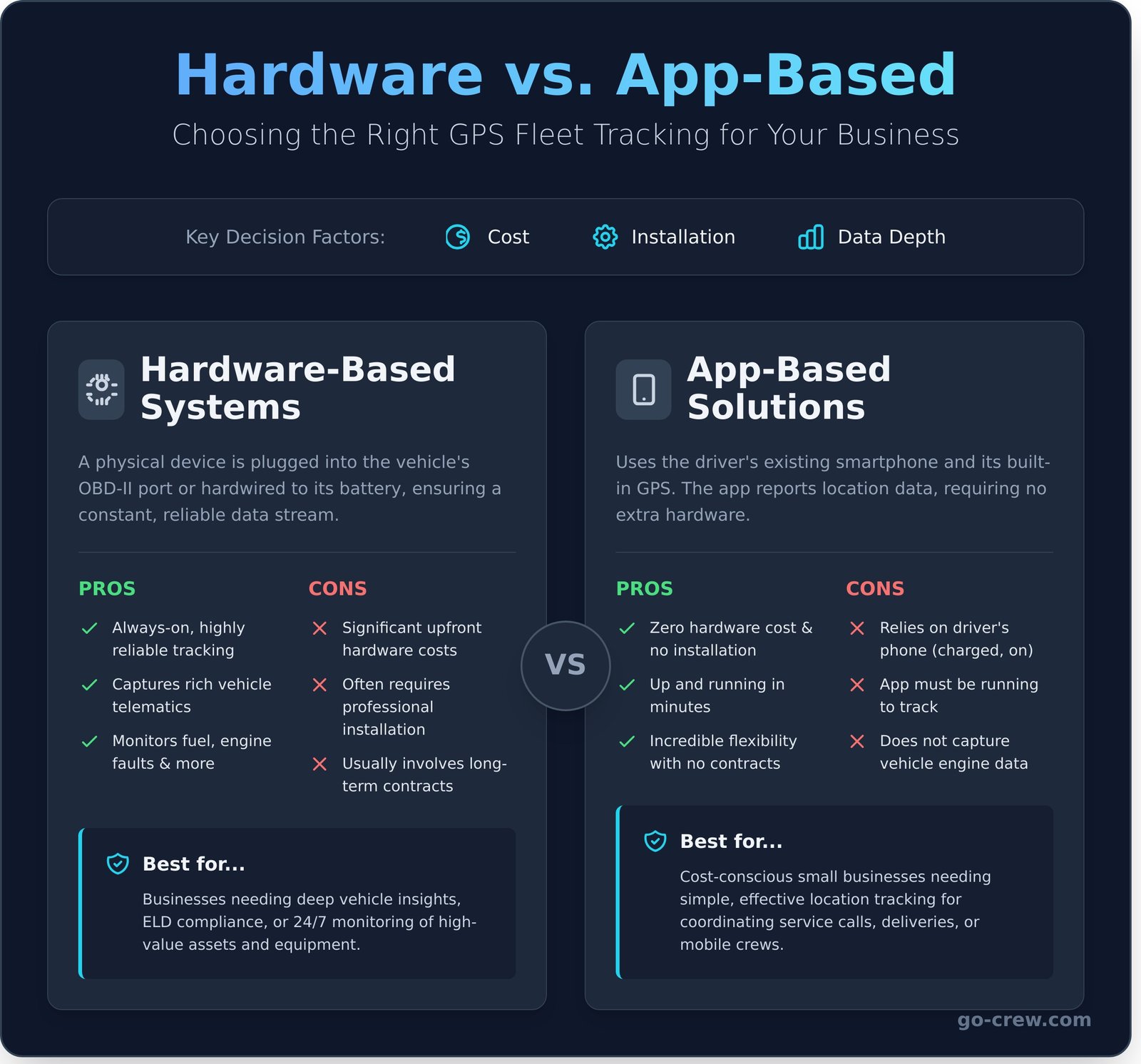
When it comes to managing your mobile team, choosing a tracking system is your most critical decision. The market is split into two distinct paths: traditional hardware plugged into your vehicles or modern apps running on your drivers’ smartphones. While many guides to the best GPS fleet tracking software cover complex feature sets, your choice really boils down to three things: cost, installation, and the depth of data you truly need.
Traditional Hardware-Based Systems
These systems use a physical device, either plugged into a vehicle’s OBD-II port or hardwired directly to its battery. This ensures the tracker is always powered and connected, providing a constant stream of information.
- Pros: Always-on, highly reliable tracking. Captures rich vehicle telematics like engine fault codes, fuel usage, and harsh braking events.
- Cons: Significant upfront hardware costs, often requires professional installation, and usually involves long-term service contracts.
Best for: Businesses that require deep vehicle insights for maintenance, need to meet ELD compliance regulations, or want to monitor high-value assets 24/7.
Modern App-Based Solutions
This approach turns your driver’s existing smartphone into a powerful tracking device. The app simply uses the phone’s built-in GPS to report its location in real-time, making it an incredibly accessible form of gps fleet tracking.
- Pros: Zero hardware cost and no installation time. You can be up and running in minutes. Offers incredible flexibility with no contracts.
- Cons: Relies on the driver to have their phone on, charged, and the app running. Does not capture vehicle-specific engine data.
Best for: Cost-conscious small businesses and teams that need a simple, effective location tracking solution without the overhead. Perfect for coordinating service calls, deliveries, or mobile crews.
Go Crew: The Simple App-Based Alternative
Go Crew is a prime example of the app-based philosophy done right. It strips away the complexity to focus on one thing: providing instant, real-time visibility of your entire group on a single map. It’s designed for teams who just need to know where everyone is right now, without the clutter of enterprise-level features. Fast, simple, and effective.
See how easy fleet tracking can be.
Essential Features Every Small Business Fleet Tracker Should Have
When choosing a gps fleet tracking system, it’s easy to get lost in a long list of features. But you don’t need a hundred different tools-you just need the right ones. The most effective apps focus on core functionalities that solve real-world problems and deliver an immediate return on investment. Use this as your essential checklist when evaluating options.
Real-Time Location Tracking
This is the non-negotiable foundation. At a minimum, you need to see your entire fleet on a live map in real-time. Look for systems that offer different map views, like satellite and live traffic overlays, and have fast refresh rates (every 10-15 seconds). This isn’t just about watching dots on a screen; it’s about operational agility.
- Problem Solved: An urgent, last-minute job comes in. Who is closest?
- The Benefit: Instantly identify and dispatch the nearest driver, cutting fuel costs, improving response times, and boosting customer satisfaction.
Trip History and Route Replay
Where have your vehicles been? A solid tracking app acts as your fleet’s perfect memory, logging every trip with details on routes, stops, and duration. The best systems provide easy-to-read reports and allow you to filter by date and vehicle, then replay a specific route on the map. This data is your proof.
- Problem Solved: A customer disputes an invoice, or you need to verify a driver’s timesheet.
- The Benefit: Resolve conflicts with concrete data, confirm hours worked, and analyze past routes to identify more efficient paths for future jobs.
Geofencing and Alerts
Geofencing allows you to draw virtual boundaries around real-world locations on your map. Think of them as digital fences around your office, key job sites, or supply houses. The system then automatically alerts you via push notification or email whenever a vehicle enters or leaves one of these zones. It’s simple automation that works 24/7.
- Problem Solved: You need to track arrivals at a job site or prevent unauthorized after-hours vehicle use.
- The Benefit: Automate your arrival and departure logs for more accurate billing and eliminate unauthorized trips, securing your valuable assets.
Mastering these three core features will transform your operations. While many of the best GPS fleet tracking software providers offer advanced tools like driver safety scoring, these essentials are what drive immediate efficiency and control for any small business. Focus on a system that does the basics flawlessly.
How to Choose the Best GPS Tracking Solution in 4 Simple Steps
Navigating the world of gps fleet tracking can feel overwhelming. With complex features and confusing price sheets, how do you find the right fit without the headache? It’s easier than you think. This simple, four-step framework cuts through the noise, empowering you to choose a solution that saves you time and money from day one.
Step 1: Define Your ‘Must-Have’ Needs
Before you look at any apps, look at your own operations. Start by answering a few direct questions. How many vehicles are in your fleet now, and how many will you add in the next year? Do you just need real-time location, or are advanced features like driver behavior scores and maintenance alerts critical? Create a short, focused list of your top 3-5 non-negotiable requirements. This simple list will be your guide and prevent you from overpaying for features you’ll never use.
Step 2: Compare Pricing Models (and Hidden Costs)
Most traditional systems operate on a per-vehicle, per-month SaaS model, which seems straightforward. However, the total cost is often buried in the details. Always watch out for extra charges that can quickly inflate your budget. These often include:
- Hardware Costs: The price of the physical tracking device for each vehicle.
- Activation Fees: A one-time charge to get your devices online.
- Long-Term Contracts: Locking you into a multi-year commitment with penalties for early cancellation.
In contrast, modern app-based solutions often provide more transparent pricing without the need for expensive hardware or installation, making them a cost-effective choice for dynamic fleets.
Step 3: Prioritize Simplicity and Ease of Use
The most powerful tool is the one your team will actually use. Ask yourself: can you set it up yourself in minutes, or does it require a technician and hours of training? Is the app or web dashboard intuitive? A complex system with a steep learning curve quickly becomes an expensive, unused asset. Your chosen gps fleet tracking solution should simplify your workflow, not complicate it. Remember, a system you don’t use is worthless. Go Crew is designed for simplicity. Try it now.
Step 4: Test Drive Your Top Choices
Never commit to a system without seeing it in action. The best providers are confident in their product and will offer a free trial or a live, no-obligation demo. Use this opportunity to test the software against your ‘must-have’ list from Step 1. Does it work as advertised? Is the interface fast and responsive? This final step ensures your choice is not just a good fit on paper, but the perfect tool for your team in the real world.
The Simple Path to Smarter Fleet Management
Choosing the right system doesn’t have to be a complex task. The journey to better efficiency begins with understanding your core needs, deciding between traditional hardware and flexible app-based options, and prioritizing features that deliver real value. Ultimately, the best gps fleet tracking solution is one that empowers your team and simplifies your operations, rather than complicating them.
If you’re tired of clunky hardware and long setup times, it’s time for a smarter approach. Go Crew is designed for small businesses that demand simplicity and speed. With no hardware required, you can set up your entire crew in minutes. Join the teams who trust Go Crew for its time-saving simplicity and get a clear, real-time view of your operations instantly.
Ready for simple, no-hassle fleet tracking? Try Go Crew today!
Frequently Asked Questions about GPS Fleet Tracking
How much does GPS fleet tracking cost for a small business?
Costs are straightforward and scale with your business. Expect to pay between $15 to $45 per vehicle each month for the software subscription. Some providers may charge a one-time hardware fee per device, while others bundle it with the plan. The final price depends on the features you need, like real-time updates, driver behavior alerts, or detailed reporting. It’s a small investment for major gains in efficiency and fuel savings.
Is GPS fleet tracking hard to install?
Not at all. Installation couldn’t be simpler with modern systems. Most trackers are “plug-and-play” devices that connect directly to a vehicle’s OBD-II port in under a minute-no tools required. For more permanent or covert solutions, hardwired options are also available. Your provider can guide you, but most businesses get their entire fleet online in just a few hours, with zero downtime and no technical headaches.
Can I track my fleet from my smartphone?
Absolutely. Every top-tier GPS fleet tracking service today offers a powerful, user-friendly mobile app for both iOS and Android. You get a complete real-time overview of your entire fleet right in your pocket. Check vehicle locations on a live map, receive instant alerts for speeding or geofence breaches, and access key reports on the go. It’s designed for total control and visibility, wherever you are, without being tied to a desk.
Are long-term contracts required for GPS fleet tracking?
Long-term contracts are no longer the only option. While some providers offer discounts for 1- to 3-year agreements, many of the best services now provide flexible month-to-month or no-contract plans. This allows you to test a system or scale your service up or down as your business needs change. You have more freedom than ever to choose a plan that works for you without a major commitment, ensuring the service fits your budget.
What’s the difference between a fleet tracker and a simple location sharing app?
It’s the difference between a professional tool and a personal app. A location sharing app just shows a dot on a map. A dedicated fleet tracker is a complete business management system. It provides rich data like engine diagnostics, fuel consumption, driver safety scores for harsh braking, and detailed trip histories. This professional-grade information is essential for optimizing routes, reducing operational costs, and improving the safety of your team.
How does GPS tracking affect employee privacy?
This is a critical point, and transparency is key. Best practice is to create a clear, written policy explaining that tracking is for company vehicles during work hours only. Frame it as a tool for safety, route efficiency, and verifying job completion-not for personal surveillance. When used correctly, it protects both the company and the employee by providing an accurate record of activity and aiding in vehicle recovery if stolen.
